RSS

What Type of New Home Are You Qualified to Buy?

When you think about looking for a new home, one of the first questions that probably comes to mind is: "What type of property can I afford?" That's an important question because your price range is a major determining factor in the types and sizes of homes you should be viewing.


You don't want to waste time looking at properties that are beyond your price range. At the same time, you don't want to purchase a less-than-ideal home, only to realize later on that you could have afforded more.


So how do you determine what type of new home you are qualified to purchase?


The first step is to find out what your current property would likely sell for in today's market. I make that calculation for clients all the time. It involves reviewing what homes similar to yours have sold for recently, as well as other data — such as special features your home may have that are likely to boost the selling price.


Once you know the current market value of your home, subtract any outstanding mortgages and estimated selling expenses, and you’ll end up with an amount that can be applied to the purchase of your next home. (You may also have other funds you want to use.)


The next step is to talk to a lender or mortgage broker to see how much of a new mortgage you qualify for. (Call me if you need a recommendation.) It's important to get a Pre-Qualification or Pre-Approval. That makes the offer you make on a new home more credible.


If you want to find out the types and sizes of homes you can get into, give me a call. I'd be happy to show you the possibilities!

Read

Carbon Monoxide (CO) is invisible and odourless, so you can't actually "watch out for it". However, you should monitor for it because an excessive build-up of this gas in your home can be deadly.

Fortunately, there are many types of Carbon Monoxide detectors you can purchase — and most are effective and affordable. Some models simply plug into an outlet. (Many also have a battery backup.)


Carbon Monoxide is caused by the incomplete burning of fuel. It can be released by a faulty gas furnace, kerosene heaters, and gas fireplaces. That's why it's a good idea to install detectors in areas close to these fixtures, as well as near bedrooms.


Experts say you should always follow manufacturer's instructions when installing CO detectors, and test them regularly. You want to make sure you can hear the alarm from your bedroom.


CO build-up in homes is rare. So your detectors may never go off. But, if the alarm does sound, get everyone (including pets) out of the home and into the fresh air. Then call 911. Typically, the fire department will do an inspection and determine the source of the carbon monoxide.


A final tip: Never use your BBQ or outside grill in the garage or, especially, anywhere inside your home. The risk of CO exposure is very high and definitely not worth the convenience of a grilled burger!

Read

Price Pressure Continues on Lower-Priced Housing in the Capital Regional District

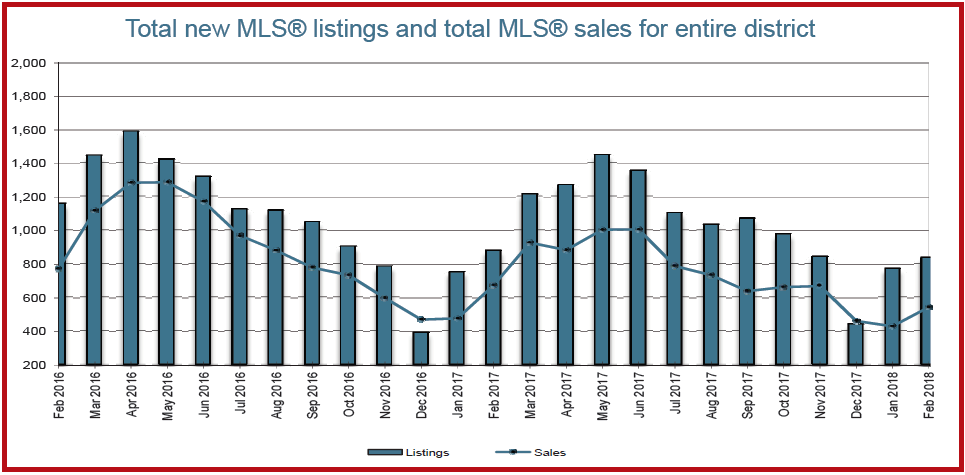
A total of 755 properties sold in the Victoria Real Estate Board region this May, 25 per cent fewer than the 1,006 properties sold in May of last year, and a 2.5 per cent decrease from April 2018. The sales of condominiums were down 17.4 per cent from last year in May with 237 units sold. Sales of single family homes were down 23 per cent from 2017 with 406 sold this May.


“It’s no surprise that our current market is very different than it was last year,” says Victoria Real Estate Board President Kyle Kerr. “Due to recent changes in mortgage qualification rules, many buyers’ purchasing power has been reduced. Unfortunately, in our area we have one third fewer single family homes for sale under $750,000 when compared to last year, so we’re seeing pressure from increased competition on a smaller number of homes, which is really pushing the under million dollar market. We have a much larger inventory of higher value homes this year. For listings priced at $1.5 million and above, the number of active listings is almost 50% higher than last year at this time. Arguably, many of these properties may be listed due to new and incoming taxes from the provincial government. The Foreign Buyer Property Transfer Tax, the Speculation Tax, and the increased School Tax are putting pressure on those high value home owners. Unfortunately, these taxes are not resulting in what the government said it intends - to increase the availability of affordable housing.”


There were a total of 2,394 active listings for sale on the Victoria Real Estate Board Multiple Listing Service® at the end of May 2018, an increase of 19.6 per cent compared to the month of April and 26.3 per cent more than the 1,896 active listings for sale at the end of May 2017.


“We’re in an interesting time here – we are seeing different levels of price pressure and price relief in micro-climates of our area,” adds President Kerr. “You may find more flexibility if you are shopping for a multi-million dollar estate in certain areas. You may be in for a competition if you’re shopping for a lower priced home or condominium. If you’re thinking of buying or selling, it’s a good idea to meet with a local REALTOR® to understand how the current environment will affect you.”


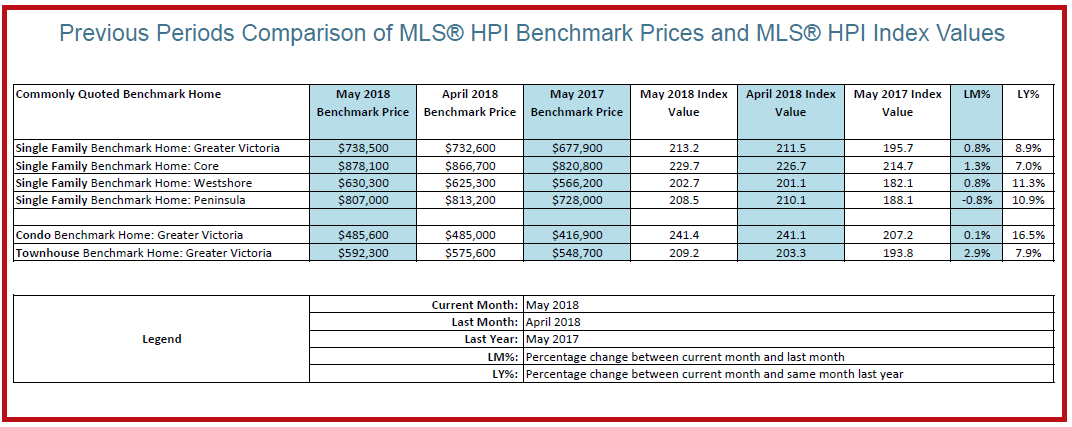
The Multiple Listing Service® Home Price Index benchmark value for a single family home in the Victoria Core in May 2017 was $820,800, while the benchmark value for the same home in May 2018 increased by 7per cent to $878,100, higher than April’s value of $866,700. The MLS® HPI benchmark value for a condominium in the Victoria Core area in May 2017 was $426,900, while the benchmark value for the same condominium in May 2018 increased by 15.7per cent to $493,900, slightly lower than April’s value of $495,100.

Read

Slower start to spring does not signal lower prices for Victoria real estate market


A total of 774 properties sold in the Victoria Real Estate Board region this April, 12.5 per cent fewer than the 885 properties sold in April last year, but a 12.5 per cent increase from the month previous. The sales of condominiums were down 21.6 per cent from last year in April with 225 units sold. Single family homes were 8.1 per cent down from the year previous with 420 sold this April.


“We’re now into the spring real estate market, which is traditionally the busiest time of the year for buying and selling homes,” says Victoria Real Estate Board President Kyle Kerr. “Last year, the months of May and June were the busiest, so we may see this pattern again but on a slightly smaller scale than last year, since our sales for the year thus far are down about 18 per cent when compared to 2017. Although January to March was quite far behind last year’s pace, we may see that margin get smaller as we progress through the spring months and people adjust to the new mortgage qualifying rules.”


There were a total of 2,002 active listings for sale on the Victoria Real Estate Board Multiple Listing Service® at the end of April 2018, an increase of 13.4 per cent compared to the month of March and 18.5 per cent more than the 1,690 active listings for sale at the end of April 2017.


“We continue to see low inventory in our market, and good homes in desirable locations are still seeing multiple bids,” adds President Kerr. “One interesting development we are tracking is the increase of prices in a market of fewer sales. Part of the reason for this is that there is strong pressure on lower-priced properties. After the new mortgage rule changes this year, many consumers have seen a reduction in their buying power, so more are competing for lower-priced properties and in multiple offer situations, pricing is pushed up. Our area just doesn’t have the supply or mix of homes needed to meet the demand. We are working with government at all levels to identify ways to meet this demand in the CRD.”


The Multiple Listing Service® Home Price Index benchmark value for a single family home in the Victoria Core in April 2017 was $800,100, while the benchmark value for the same home in April 2018 increased by 8.3 per cent to $866,700, higher than March’s value of $859,400. The MLS® HPI benchmark value for a condominium in the Victoria Core area in April 2017 was $418,200, while the benchmark value for the same condominium in April 2018 increased by 18.4 per cent to $495,100, which is higher than March’s value of $490,000.

Read

Beware of Over-Downsizing or Over-Upsizing

Buying a new pair of shoes is relatively easy. Once you find the style you like, all you need to do is try them on and see if they fit. If they do, you go to the cash register and pay.


When it comes to size, buying a new home can be trickier! Whether your intention is to upsize or downsize, figuring out the right size can be especially challenging.


Say for example, you’re downsizing from a large two-story home to a smaller bungalow. You don’t want to underestimate the space you need and end up in a place that feels tight. If you’re going the other way and upsizing, you don’t want to end up sinking extra money into a property that’s larger than you really need.


So how do you avoid these scenarios?


One of the best ways is to start by considering your current home. Do you use all the rooms in your home regularly? Is there a bedroom that’s rarely occupied? Has the recreation room become simply a storage area? If you’re downsizing, subtracting rooms you scarcely use can give you a better idea of what you need in a new home.


Upsizing is a bit more challenging because you have to anticipate what you will need in the future. For example, if you have young children, and your place is feeling cramped, then a home with a recreation room or separate family and living rooms may be a good idea. You may also need a bigger kitchen with a spacious eating area (in addition to a separate dining room.) Think about the extra room you’ll need and how you’ll use that space.


When I work with a client, I typically sit down with them and discuss the type of home they want in detail — and, based on needs and circumstance, I make expert recommendations. Bottom line, I help clients find the perfect fit in a new home. Contact me if you’d like to learn more.

Read

The Basics of Do-it-Yourself Video-based Home Security


According to law enforcement experts, a video-based home security system is significantly more effective than a simple alarm system. The reason is obvious. Burglars don’t want their crimes captured on video, which can then be used as evidence in court.


So it’s no wonder that many homeowners have, or are considering, video-based security.


These days, most video-based home security systems are wireless. The cameras either record to your DVR (just like recording your favourite TV show), or to a cloud-based server provided by the manufacturer.


There are many do-it-yourself systems on the market. You simply place the cameras around your property and do some initial setup. Most of these have motion-detection that records automatically when someone comes into the frame of the camera. These are typically installed at your front door, patio door, main floor windows, and garage door.


Some systems will even alert you when a camera turns on, and let you see the action on your smartphone or computer. If it’s a burglary attempt, you have the opportunity to call the police.


Although most of these products are weatherproof, check and confirm before purchasing. The packaging will say something like, “Suitable for outdoor use” or “Suitable for all-weather conditions”.


Also look for night vision capability. Not all security cameras have that feature.

Read

5 Ways to Make the Selling Process Stress-Free

For some homeowners, the process of listing, showing and selling their home can be stressful. Fortunately, there is plenty you can do to make it much less nerve-racking—and even exciting and enjoyable.


Here are some ideas:


1. Make a plan. Decide when you’re going to show your property, search for a new home, view listings, etc. Block out these times in an agenda book or calendar. That way, you and your family can see what’s coming up.


2. Be flexible. Few things go exactly as planned! So, it’s important to build in flexibility. For example, you may plan to see homes for sale on Saturdays, but if an opportunity comes up on a weeknight, give yourself room in your schedule to jump on it.


3. Eat well. There are numerous studies that connect poor nutrition with increased stress. When people are selling and moving, there’s a tendency to rely on quick fixes, such as hot dogs and pizza! Try to plan more nutritious meals that will keep everyone healthy and energized.


4. Get stuff done early. Doing things last minute, such as finding a real estate lawyer or getting rid of clutter, can quickly lead to stress and frustration. Whenever possible, get tasks done early. That way, you won’t have to worry about them.


5. Hire the right professionals. By far, the surest way to a stress-free move is to get the right professionals working for you: everyone from contractors to mortgage brokers to movers.


By the way, a big part of what I do for clients is help make every aspect of buying, selling and moving go smoothly. Contact me to learn how I can help you.

Read

Creating a Practical Home Office


Is your home office the dining room table? Is it anywhere you can sit down undisturbed with your laptop? If so, you might be interested in converting a room or nook into a dedicated home office. Depending on what you do for a living, there could be a tax advantage to creating this space too.


The first step is to pick a spot. Ideally, you want an area where you can work without too many distractions.


Next, make sure the spot you’ve chosen can accommodate a desk and any other furnishings you’ll need. Think about what you want within easy reach of your work area. Will you need a place for books and other papers? An extra chair for client meetings? A flipchart? A filing cabinet? Think about all of the options in advance.


Then, you’ll want to make sure the spot you picked has the electrical outlets you need, especially if you’re going to have a printer, special lighting, a computer and other items that need power.


Finally, you’ll want your home office to be a place where you can enjoy working. So decorate it with that in mind. If you like plants, get plants. If you enjoy golf, have your golf trip pictures hanging on the wall.


With a little work, you can quickly create a home office space that is comfortable, functional and enjoyable. It sure beats the dining room!

Read

Outside Influences Impact Spring Real Estate Market in Victoria


A total of 688 properties sold in the Victoria Real Estate Board region this March, 25.9 per cent fewer than the 929 properties sold in March last year, but a 26.2 per cent increase from the month previous. The sales of condominiums were down 28.2 per cent from last year in March with 211 units sold. Single family homes were 30.8 per cent down from the year previous, with 337 sold this March.


“As we expected, March sales are tracking lower than in 2017,” says Victoria Real Estate Board President Kyle Kerr. “This is likely due to a number of factors that have created hesitation in consumers, including recent heavy measures by the provincial government to reduce the value of home prices and the federal government’s new mortgage qualification rules. Combine these factors with rising interest rates and you’ve got a housing market that is in transition due to outside influences. Every time there is intervention into a market, it takes a few months for the market to rebalance. With the continual changes of late from different levels of government, our market is experiencing a new cycle of ongoing uncertainty.”


There were a total of 1,766 active listings for sale on the Victoria Real Estate Board Multiple Listing Service® at the end of March 2018, an increase of 14.3 per cent compared to the month of February and 13.5 per cent more than the 1,556 active listings for sale at the end of March 2017.


“Despite all of the above, we continue to see benchmark price increases across our market and demand persists - partly due to low inventory - but also because of our highly desirable location,” adds President Kerr. "Specific areas and price points are experiencing varying pressure on price and demand – which creates micro-markets. We are still seeing multiple offers and above asking price sales in some segments. Active buyers in our market may see some relief as inventory is slowly growing. This showcases why it is important to work with your local REALTOR® in this transitioning market to ensure you have the most up-to-date information to make purchasing and selling decisions.” 


The Multiple Listing Service® Home Price Index benchmark value for a single family home in the Victoria Core in March 2017 was $785,600, while the benchmark value for the same home in March 2018 increased by 9.4 per cent to $859,400, higher than February’s value of $840,300. The MLS® HPI benchmark value for a condominium in the Victoria Core area in March 2017 was $409,700, while the benchmark value for the same condominium in March 2018 increased by 19.6 per cent to $490,000, which is higher than February’s value of $472,600.

Read

Open House Questions Some Buyers Forget to Ask

An Open House is an event. And, like many events, it’s easy to get caught up in all the excitement and energy. In fact, when you visit an Open House, you might even end up rubbing elbows with other buyers who are there at the same time. It can feel like a party!


In an environment like that, it’s not unusual to forget to ask important questions about the property. Here are some of the most common:


• How old is the roof?
• How old is the furnace, air conditioner and other HVAC equipment?
• How does the price compare to similar properties in the neighbourhood? (You don’t want to make an offer that’s too high.)
• What are the characteristics of the neighbourhood? (Amenities, safety, traffic, access to public transit, property turnover, etc.)
• What doesn’t come with the home? (Ask specifically about kitchen appliances, gas-connected BBQs, chandeliers, window coverings.)
• Are there any potential impediments to the sale? (Tenants, outstanding liens, etc.)
• Are there any outstanding maintenance issues, or repairs that need to be done? (For example, cracked ceramics on the foyer floor.)
• Are there any issues that impact the full use of the property? (Ask specifically about shared driveways or walkways, public “right of way” through the property, water drainage rights from neighbouring homes, etc.)


Yes, an Open House can feel like a frenzy, and if it’s a home you love, you might feel pressured to make an offer. But, it’s important to take the time to ask the right questions and consider your decision carefully. You don’t want to find out, too late, that there were questions you should have asked.


Want more tips on finding the home of your dreams? Call today.

Read

What You Need to Know about “Interest Free” Deals


Next to your home and car, home furnishings represent the most expensive product purchases homeowners make. A mid-quality livingroom set, with sofa and two side chairs, can cost thousands of dollars. That’s why most furniture retailers offer “interest free” and “pay much later” deals to soften the blow.


These are basically financing options.


Say, for example, you want to purchase furniture for the rec room. The cost is $7,200. The furniture retailer may offer you a deal where you “don’t pay a cent” for six months. As long as you pay the balance within that time, no interest is charged.


That sounds like a sweet deal. And it is.


But, personal finance experts will advise you to tread carefully. If you pay off the balance within the “no interest” timeframe, you’ll benefit from the sweet deal, by having deferred the payment. However, if you fall behind on payments, you’ll be hit with a high interest charge. It’s often 20% or more. That can add hundreds of dollars to what you would have originally paid for the purchase.


And, even if you paid down most of the balance within the no interest period, you can still get hit hard. Some “no interest” deals charge interest on the original financed amount — not just the remaining balance.


The best advice, according to personal finance experts, is to read the fine print carefully and pay off the balance as promptly as you can.

Read

Victoria Real Estate Market Adapts to Changing Policy Landscape


March 1, 2018 - A total of 545 properties sold in the Victoria Real Estate Board region this February, 19.3 per cent fewer than the 675 properties sold in February last year. The sales of condominiums were down 15.5 per cent from last year in February with 174 units sold. Single family homes were 24.4 per cent down from the year previous, with 260 sold this February.


“We certainly anticipated that we would see some lower numbers this year compared to last,” says Victoria Real Estate Board President Kyle Kerr. “Right now prospective home buyers are met with many hurdles as they start shopping for their new home. They’re in a market that’s experienced long-term low inventory, which means more price pressure and competition on homes. Buyers are navigating increasing interest rates and the new mortgage stress test. These factors all combine to constrain our market. Like any changes to consumer experience, there is a period of response before consumers adapt to the new rules. We saw an increase in buyers in November and December who bought early to avoid the mortgage stress test, and this likely means less buyers in the current market. However, with continued historical low inventory levels, demand is still outpacing supply.”


There were a total of 1,545 active listings for sale on the Victoria Real Estate Board Multiple Listing Service® at the end of February 2018, an increase of 3.6 per cent compared to the month of January and 0.5 per cent more than the 1,537 active listings for sale at the end of February 2017.


“The provincial government recently rolled out its budget, which includes an admirable commitment to spend six billion dollars to build 114,000 units in ten years,” adds President Kerr. “These units will take years to come to market, and it is difficult to predict how many we will see in Victoria. The government needs a long-term approach to supply needs in our area, and that initial commitment is a good start. A reasonable way to bolster their commitment and improve current conditions is for the province to work with our municipalities to reduce the timelines and costs associated with bringing new housing to our market.”


The Multiple Listing Service® Home Price Index benchmark value for a single family home in the Victoria Core in February 2017 was $771,100, while the benchmark value for the same home in February 2018 increased by 9 per cent to $840,300, slightly higher than January’s value of $831,900. The MLS® HPI benchmark value for a condominium in the Victoria Core area in February 2017 was $394,400, while the benchmark value for the same condominium in February 2018 increased by 19.85 per cent to $472,600, which is slightly higher than January’s value of $460,500.

Read
MLS® property information is provided under copyright© by the Vancouver Island Real Estate Board and Victoria Real Estate Board. The information is from sources deemed reliable, but should not be relied upon without independent verification.