RSS

Imagine going to a restaurant with your family for dinner. You're planning on ordering a nice pasta and salad. Your heart is set on it. But, after you go to the trouble of driving there and getting a table, you discover that pasta is not on the menu.


That’s disappointing!


Of course, it’s only a meal. You can go somewhere else next time. But, what if the same scenario played out once you had moved into a new neighbourhood? Imagine you were counting on public transit being in easy walking distance, but discovered the nearest stop is four blocks away. Argh!


That's why it's important to ensure a neighbourhood has the characteristics you want — before you make an offer on a home you like. Think about what you want most in a neighbourhood. Consider work, commuting, schools, playgrounds, noise level, walking and cycling, hobbies, shopping, entertainment, etc.


If there is a neighbourhood feature that is very important to you, check it out for yourself. For example, if easy access to a main highway is desirable for commuting, take the route for a test drive.You can get a lot of information on a neighbourhood through the listed property's description and MLS listing.


Want more in-depth insights into an area you're considering? I have that information. Call today.

Read

Victoria Real Estate Market’s cool conditions continue


A total of 329 properties sold in the Victoria Real Estate Board region this January, 23.7 per cent fewer than the 431 properties sold in January 2018 and a 12.3 per cent decrease from December 2018. Sales of condominiums were down 5.9 per cent from January 2018 with 111 units sold but were up from December 2018 by 7.8 per cent. Sales of single family homes were down 29.3 per cent from January 2018 with 152 sold.


“It’s already an interesting year for local real estate. REALTORS® are keeping busy showing homes and writing offers, however actual sales are slower than we would expect in an average January,” says 2019 Victoria Real Estate Board President Cheryl Woolley. “There are many reasons consumers are hesitant to purchase. For instance, changes to mortgage lending rules have decreased the amount of funds buyers can qualify for by up to twenty-five per cent. In turn, some consumers are re-evaluating their expectations and looking at condos and townhomes rather than single family homes; or they are looking at single family homes further outside the core. As well, many buyers appear to be waiting for new inventory to open up, while sellers are watching the market closely to see what their homes are worth and what the spring market may bring.”


There were 2,057 active listings for sale on the Victoria Real Estate Board Multiple Listing Service® at the end of January 2019, an increase of 3.5 per cent compared to the month of December and a 38 per cent increase from the 1,491 active listings for sale at the end of January 2018. The Multiple Listing Service® Home Price Index benchmark value for a single family home in the Victoria Core in January 2018 was $840,100. The benchmark value for the same home in January 2019 increased by 0.9 per cent to $847,800, lower than December’s value of $858,600. The MLS® HPI benchmark value for a condominium in the Victoria Core area in January 2018 was $471,300, while the benchmark value for the same condominium in January 2019 increased by 6 per cent to $499,700, slightly lower than December's value of $502,400.


“Over the past few years, demand in Greater Victoria has outstripped supply, putting upward pressure on pricing. While many of the new developments proposed for our region are being built for much needed rental and social housing units, it will provide little relief for buyers who are caught in the pinch between tougher lending rules and higher prices,” adds President Woolley. “Moving forward, we anticipate continued interest in our region as people gravitate towards our mild climate, beautiful amenities and the lifestyle Greater Victoria offers.”

Read

9 Steps to Finding your Next Dream Home

If you're thinking ahead to your next dream home, the road you need to take to get there may seem confusing. Do you search for listings online? Drop by Open Houses on the weekends? Call the number on For Sale signs? Let's break it all down!


Here are the specific steps you need to take to ensure you find a home that fits your wants, needs and budget.


1. Find out how much your current property will likely sell for on today’s market.
2. Arrange for financing, so you know what you can afford.

3. Select neighbourhoods you'd love to live in. (That may involve some fun exploring!)
4. Decide on the type of home you want to buy. (For example: detached, three-bedroom, etc.)
5. Prioritize the property features you want most, so you can be flexible if a feature is missing from a home listed on the market that is otherwise ideal.
6. View properties on the market that closely fit your criteria, particularly new listings that may not yet be posted online. (Tip: Arrange to be immediately notified of new listings that are a good fit for you.)
7. When you find a home you want, make an offer designed to get the property — without overpaying.
8. Negotiate until you secure the deal. This may involve counter-offers.
9. If the negotiation is skillfully done and all goes well, the home is yours.


As you can see, there isn't a lot of mystery in finding your next dream home. You just need to take the steps and get the professional help you need along the way.


Looking for a real estate agent that can get you to the finish line? Call today!

Read

Moving around the corner or even across town is relatively simple because you are likely familiar with the various neighbourhoods and you can access them anytime. If there's a listed home you want to view, you can simply go see it.


Relocating to a different town or city, however, is much more challenging. It may not be possible for you to make multiple visits to see homes for sale. You may also be unfamiliar with the various neighbourhoods. So what do you do if you want to move out-of-town or need to relocate due to work?


Your first step is to get the information you need. You'll want up-to-date data on the neighbourhoods so you can pinpoint the ones that are the best fit for your needs and lifestyle. You'll also want to get a sense of the types of homes
for sale in those neighbourhoods — style, size, features, listing price, etc.


Your next step is to schedule a day to view homes. This visit must be carefully planned so you only see those properties that are likely to be of interest. You don’t want to travel all that way only to end up seeing properties you wouldn't likely buy. What a waste of time!


So, if you’re relocating, you’ll need help. Give me a call. I can help make the
relocation go smoothly for you.

Read

For some people, the thought of listing their home for sale is stressful. They worry about all the things they have to do — and all the things that might go wrong.


Luckily, it doesn't have to be that way. Here are some tips for making your home sale go smoothly:


- Give yourself time to prepare. If you're thinking of selling six months from now, start preparing your property now. Do any necessary staging, and get it looking its best. Avoid doing these tasks at the last minute.


- Set the right price. Pricing your property too high will likely result in few, if any, buyers coming to see it. You might end up having to lower your price later, causing your home to linger even longer on the market. That's stress you don't need!


- Have a flexible viewing schedule. If you make it too difficult for buyers to see your property, they might lose interest or simply choose to buy another home. Be as flexible as possible when a buyer wants to view your property.


- Plan get-away activities. When a buyer comes for a scheduled viewing, don't be home. Instead, plan some fun activities for your family. Think: playground, shopping, cycling, etc.


- Accept the ups and downs. Prospective buyers might say they love your home and plan to make an offer. Then you don't hear from them again! It happens! Accept the inevitable ups and downs of selling your home.  


- Get help with repairs. You'll probably have things that need to be fixed around the home, like a dripping faucet that needs repair or a room that needs painting. If possible, hire a professional to do some of that work.


- Finally, work with a great real estate agent. That will make the biggest difference in ensuring your move goes smoothly and stress-free.


Looking for a real estate agent like that? Call me!

Read

Imagine you've found the perfect home. You love it. You've made an offer that's been accepted. So far so good! The only catch? You've wisely made the offer conditional on passing a professional home inspection.


What happens if that home inspection reveals a major issue?


First, you should know that, depending on the age of the property, a home inspection will typically turn up at least a few areas of concern. The inspector might find loose insulation in the attic that is thinning out or roofing shingles that will need replacing in two or three years.


Issues like those are not usually deal-breakers.


However, if the home inspector finds a major issue — such as old wiring that's worn and presents a safety concern — then you're facing a potentially high cost of repair should the deal go through.


In a situation like that, as your real estate agent, I will address the issue with the seller, usually through the seller's agent. Since neither of you will want to lose the deal, the seller often agrees to get the repair done at his own expense or, have some or all of the estimated repair cost deducted from the sale price.


Will the deal be in jeopardy? Usually not. In most cases, if you have a real estate agent like me working in your best interests, it all works out.

Read

Victoria Real Estate Market responds as expected to the changing market conditions of 2018


A total of 375 properties sold in the Victoria Real Estate Board region this December, 18.8 per cent fewer than the 462 properties sold in December 2017 and a 24.7 per cent decrease from November 2018. Sales of condominiums were down 24.3 per cent from 2017 in December with 103 units sold. Sales of single family homes were down 26.6 per cent from December 2017 with 174 sold.


A grand total of 7,150 properties sold over the course of 2018, 20 per cent fewer than the 8,994 sold in 2017. 2018 sales came in very close to the ten-year average of 7,351 properties sold. Condominium sales totalled 2,162 in 2018, compared to 2,783 in 2017. Single family home sales were down from 4,069 in 2017 to 3,187 in 2018.


“The story arc in real estate this year has been the impact of government influence on a market which was showing signs of levelling out through the latter part of 2017,” says outgoing Victoria Real Estate Board President Kyle Kerr. “All levels of government turned their focus to try to make housing more affordable and attainable across the property spectrum. The federal government’s change to mortgage lending qualification rules this year meant many consumers lost 20 per cent of their purchasing power, which contributed to slowing down the pace of the market. On a municipal level, we saw many councils activating how they can influence affordable housing by leveraging current land assets, acquiring new land and creating partnerships to bring new affordable units to market - and that’s a very exciting thing for our market in the long term. The provincial government has also promised huge investments into new affordable developments. These developments are important to the long-term growth of our community, because the only way to make more affordable housing in our area is to build it.”


There were 1,988 active listings for sale on the Victoria Real Estate Board Multiple Listing Service® at the end of December 2018, a decrease of 15.2 per cent compared to the month of November but 43.6 per cent more than the 1,384 active listings for sale at the end of December 2017.


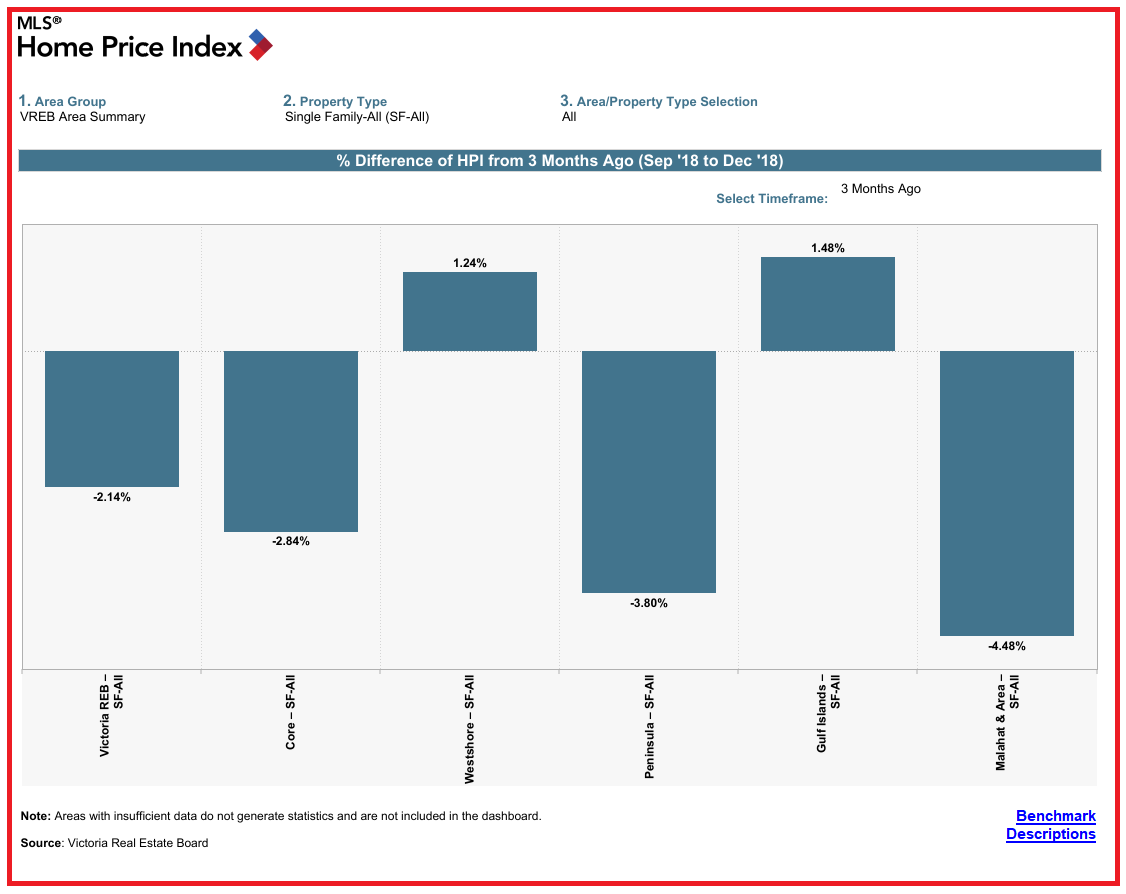
The Multiple Listing Service® Home Price Index benchmark value for a single family home in the Victoria Core in December 2017 was $832,000. The benchmark value for the same home in December 2018 increased by 3.2 per cent to $858,600, lower than November’s value of $865,200. The MLS® HPI benchmark value for a condominium in the Victoria Core area in December 2017 was $464,300, while the benchmark value for the same condominium in December 2018 increased by 8.2 per cent to $502,400, slightly more than November's value of $500,500.


“The market in 2019 will continue to be quieter than in previous years, as buyers and sellers adjust to new market conditions and government policies,” adds President Kerr. “Inventory is still quite low when you look at a longer range, which will continue to put pressure on pricing. Our overall economy is predicted to slow slightly, and that will likely mean a slower increase in interest rates but also slower growth. The good news is that savvy buyers will have more time to find their new homes, and that sellers will be under less pressure if they are planning to move within our market. Remember in evolving markets like ours, it’s important to enlist the services of a REALTOR® to help you navigate what may be your largest transaction ever.”

Read

Wouldn't it be nice if you had all the time in the world to find your next dream home? You could leisurely browse the current listings, select homes you'd like to see, schedule visits on dates that are most convenient for you, and make an offer on a property only after you've had plenty of time to consider all the alternatives.


Sure, that sometimes happens, but it's not typical. Often, people shopping for a home are on a timeline. Sometimes a very tight timeline.


So how do you find your next dream home when you don't have all the time in the world?


First, you need to develop a clear picture of the home you're looking to buy. How many bedrooms? What size of property? What type of structure (two story, back split, etc.)? Then, you need to list your preferences. These might include "large kitchen" or "main floor office".


Once you've completed that exercise, you'll have a more detailed profile of the type of property you want. That will make it easier to decide which of the listings on the market you want to see.


You should also narrow down the area in which you'd like to live. If you have three or four targeted areas, and only consider listings in those areas, your home search will be much faster.


What if you don't know the neighbourhoods well? Visit a few. Drive around. Explore. Get as much neighbourhood data as possible, such as demographics, recreational activities, parks, shopping, schools, etc. Then choose the neighbourhoods that fit your lifestyle.


Finally, the best way to find a new home on a tight schedule is to work with the right real estate agent — someone who, like me, is experienced in the local market.


Call me anytime.

Read

Is there an area you'd love to get into that's "hot"? In other words, an area where, as soon as a new home comes up for sale, buyers are clamouring to see it?


It can be intimidating to try to buy into a neighbourhood like that. On one hand, it's the type of area you'd love to call home. After all, there are good reasons why it's so popular! On the other hand, you might be discouraged by the competitiveness and prices.


If you want to live in that neighbourhood, there are a couple of things you can do that will increase your chances of success.


The first is to create a strategy. Most buyers rush to see a listing in a desirable area only when it shows up on MLS — or sometimes only when it's advertised. You'll have a better chance of getting into the neighbourhood if you are alerted the moment a property comes up for sale and you have pre-arranged financing. You’ll get to the head of the line and be ready to make a credible offer.


The second option is to consider targeting other neighbourhoods with similar characteristics. You may have long-dreamed of living in Prestigious Area A, yet there might be a Hidden Gem Area B that is just as good. Maybe it’s even better!


Ultimately, your goal is to find the home you want in a neighbourhood you like. The right strategy will get you there.


Contact me for more information.

Read

The Victoria real estate market chills out for winter


A total of 498 properties sold in the Victoria Real Estate Board region this November, 25.8 per cent fewer than the 671 properties sold in November of last year and a 16.7 per cent decrease from October 2018. Sales of condominiums were down 30.9 per cent from last year in November with 152 units sold. Sales of single family homes were down 20.8 per cent from 2017 with 267 sold this November.


“We certainly anticipated a difference this year in terms of sales for November compared to last year,” says Victoria Real Estate Board President Kyle Kerr. “This time last year, the government announced plans to change mortgage lending qualification rules and our market saw a rush of activity as buyers tried to beat that new lending criteria which was rolled out January first. Our ten-year average of units sold for the month of November is 515, which is likely a better comparison than to the unusual market conditions we saw last year.”


The Multiple Listing Service® Home Price Index benchmark value for a single family home in the Victoria Core in November 2017 was $832,800, while the benchmark value for the same home in November 2018 increased by 3.9 per cent to $865,200, lower than October's value of $881,000. The MLS® HPI benchmark value for a condominium in the Victoria Core area in November 2017 was $456,200, while the benchmark value for the same condominium in November 2018 increased by 9.7 per cent to $500,500, slightly less than October's value of $502,600.


There were a total of 2,343 active listings for sale on the Victoria Real Estate Board Multiple Listing Service® at the end of November 2018, an increase of 32.8 per cent compared to November 2017 but 6.7 per cent fewer than the month previous.


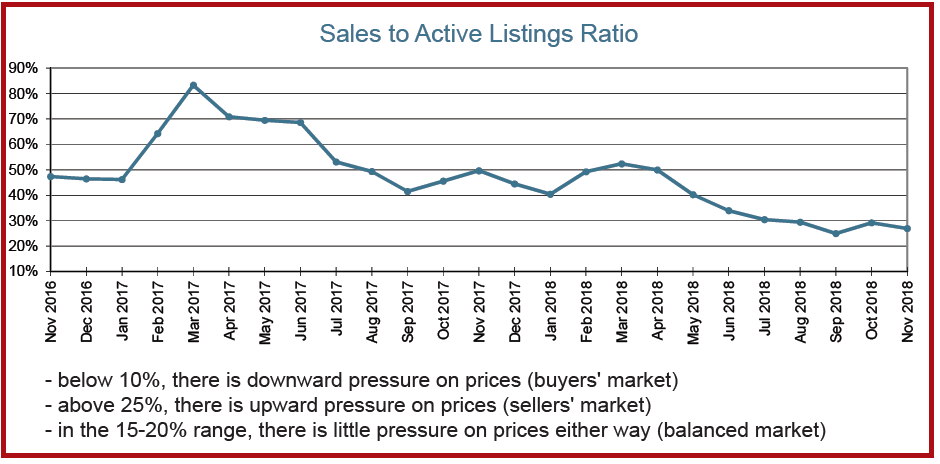
“Inventory continues to be low compared to historic averages,” adds President Kerr. “The ten-year average for active inventory in November is 3,204, so although it has improved compared to last year, we are still low on choice for buyers. At the same time, waning demand has meant that there is less urgency in our market right now, which can benefit buyers and sellers. The market tends to naturally slow down in the winter, so I’d expect we will have a more balanced market heading into the new year.

Read

When you're having a garage sale, one of the toughest tasks is pricing your items. If you put a price tag on your old golf clubs that’s too high, no one will buy them. If you make the price too low, they might sell quickly, but you’ll spend the rest of the day wondering if you could have gotten more!


It's similar to selling your home — except with your home, the stakes are much higher. You want to price your property to sell, but you don’t want to leave any money on the table.


How do you accomplish that?


Setting the right list price for your home requires a combination of skilled calculation and industry savvy. Let's start with the "calculation" part...


When you work with me, I'll review recently sold properties that are similar to yours in type, size, features and location. Then, using that data, we’ll calculate a range that represents your property's "current market value." For example, consider a spacious 15-year-old bungalow in a nice neighbourhood. If similar homes in the area have sold for $675,000-$750,000 in the last six months, then it's obvious that your home should sell in that range too. A list price above or below that range would be in the danger zone.


But skilled calculation is only half the task.


Setting your list price also requires expertise in the local market, combined with good old-fashioned gut instinct. That instinct comes from being on the front lines of many property transactions.


That's why working with a good real estate salesperson is so important, when you’re deciding on the list price for your home. Want to discuss selling your home? Call me.

Read

The Victoria real estate market’s return to balance not linear, but also not unexpected


November 1, 2018  A total of 598 properties sold in the Victoria Real Estate Board region this October, 9.9 per cent fewer than the 664 properties sold in October of last year, but a 12.2 per cent increase from September 2018. Sales of condominiums were down 15.5 per cent from last year in October with 180 units sold, but up 20.8 per cent when compared to September 2018. Sales of single family homes were down 14.7 per cent from 2017 with 289 sold this October, 1.4 per cent more than the previous month.

"We continue to see the housing market shift into a more balanced state, though the trajectory is not smooth," says Victoria Real Estate Board President Kyle Kerr. "This month had slower sales compared to last year and a slightly lower level of inventory coming into the market, but it also had an increase in sales from last month, which may surprise some people. The moderating changes over last year have been punctuated with some competition and price pressure on lower and mid-priced homes while the upper end of the market has softened slightly. Right now pricing is key across all segments as we transition to a more balanced market."

There were a total of 2,510 active listings for sale on the Victoria Real Estate Board Multiple Listing Service® at the end of October 2018, an increase of 31.8 per cent compared to October 2017 but 5.1 per cent fewer than the month previous.

"The market is definitely reacting to the changes in mortgage lending requirements," adds President Kerr. "Lending was made tougher to dampen the market and these measures have certainly had an impact on purchasing power. The threat of the looming Speculation and Vacancy tax has also cooled development in our area, which is unfortunate because the only way to create affordable homes in our area is to build them. We hope that moving forward the municipal, provincial and federal governments will work collaboratively to enable more supply at all levels of housing by funding public / private partnerships to support the increase of home stock in our area. We hope that aside from taxation and mortgage rules, governments will work together to ensure a future supply in our area to stabilize prices in the long term."

The Multiple Listing Service® Home Price Index benchmark value for a single family home in the Victoria Core in October 2017 was $830,100, while the benchmark value for the same home in October 2018 increased by 6.1 per cent to $881,000, slightly lower than September's value of $883,700. The MLS® HPI benchmark value for a condominium in the Victoria Core area in October 2017 was $457,500, while the benchmark value for the same condominium in October 2018 increased by 9.86 per cent to $502,600, slightly less than September's value of $503,000.

Read
MLS® property information is provided under copyright© by the Vancouver Island Real Estate Board and Victoria Real Estate Board. The information is from sources deemed reliable, but should not be relied upon without independent verification.