RSS

Buying a Home that Needs Some Work


When you’re shopping for a new home, you probably want the property to be as “move in ready” as possible. That way, you can... well... just move in!


However, there are a lot of fantastic properties on the market that need some work. For example, you might see a home that has everything you need, but the kitchen is long overdue for a renovation. Or, you might view a property that requires a lot of repairs and painting — tasks that, at first glance, seem overwhelming.


You don’t want to just pass on a property that might be a great buy. On the other hand, you don’t want to purchase a home, only to end up with more renovations, repairs and expenses than you anticipated.


What’s the solution? Here’s an idea.


When you view a home that needs work, make a note of exactly what needs to be done. Stick to the important “must have” improvements and leave “nice to have” improvements for a later time. Chances are, you’ll identify just one or two projects — such as “paint all the walls” or “replace the countertops in the kitchen”.


Once you have that list, you’ll be in a better position to determine how long the work will likely take and the approximate cost. This will give you some needed perspective on whether or not to buy the home.


If a home you’re considering needs $15,000 in work that can probably be completed within two months, that might make the property worth buying. In fact, it probably would!


So, when you see an otherwise ideal home that needs some work, don’t let your imagination make that work into more than it is. Take notes and get estimates.

Read

Consumer Interest in Homeownership in Victoria Unwavering Over Course of Pandemic


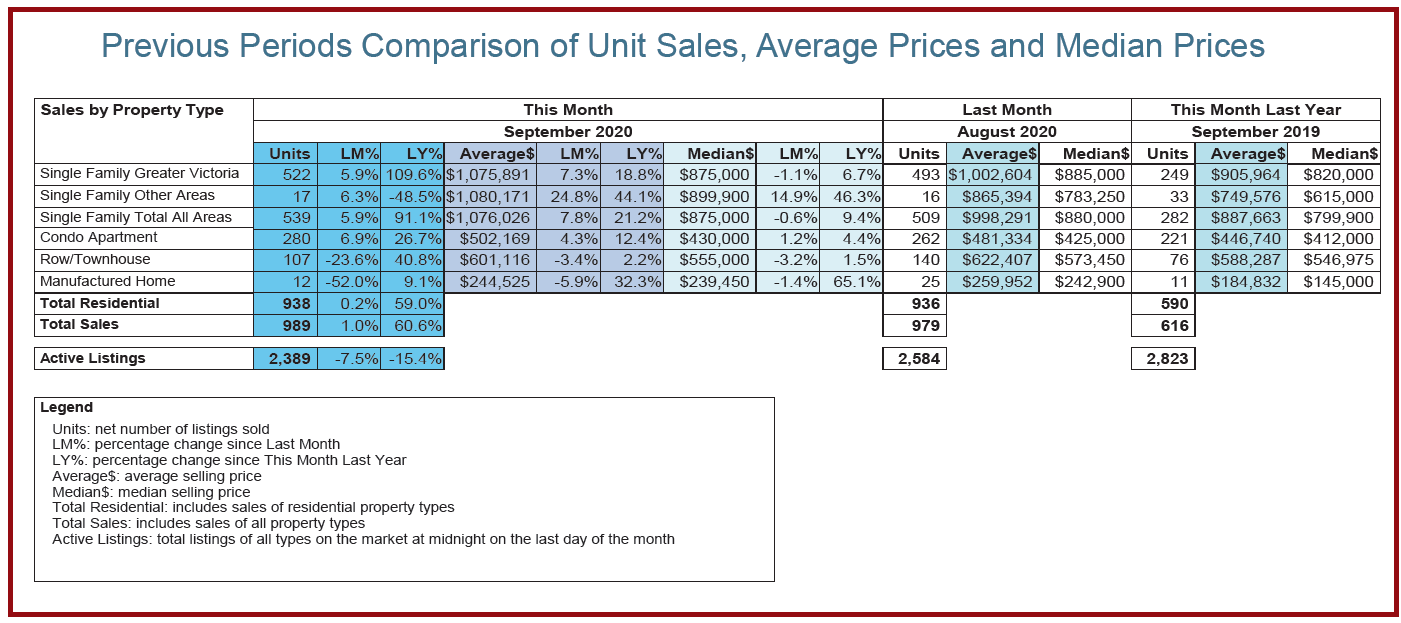
October 1, 2020  A total of 989 properties sold in the Victoria Real Estate Board region this September, 60.6 per cent more than the 616 properties sold in September 2019 and 1 per cent more than the previous month of August 2020. Sales of condominiums were up 26.7 per cent from September 2019 with 280 units sold. Sales of single family homes were 91.9 per cent from September 2019 with 539 sold.

"Another month has passed where we have seen surprisingly high sales numbers - which included quite a few higher end properties," says Victoria Real Estate Board President Sandi-Jo Ayers. "I don't think that anyone who was trying to predict market outcomes in our area over the course of the pandemic expected that the pent up demand from dampened sales in April and May would result in this level of market activity. There's no doubt that buyers are extremely motivated and this increased demand, coupled with limited inventory, fueled the September market."

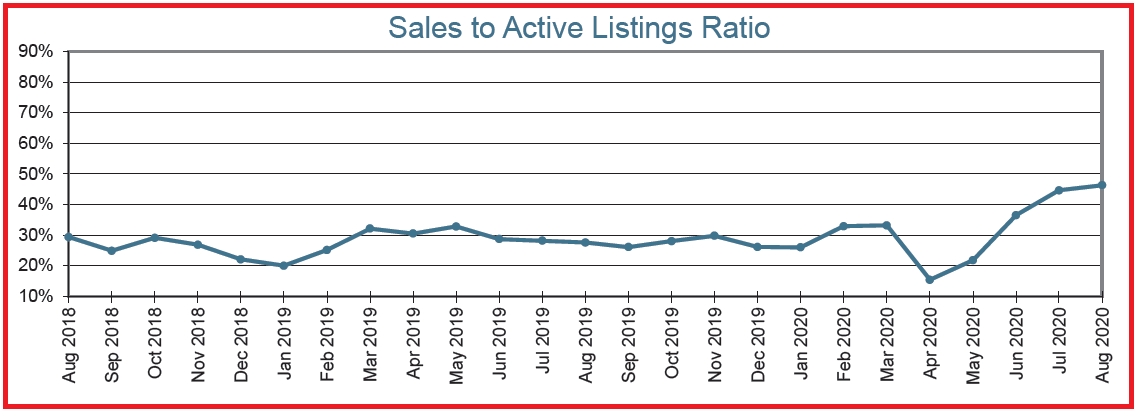
There were 2,389 active listings for sale on the Victoria Real Estate Board Multiple Listing Service® at the end of September 2020, 15.4 per cent fewer properties than the total available at the end of September 2019 and a 7.5 per cent decrease from the 2,584 active listings for sale at the end of August 2020.

"We had some much-needed new inventory enter the market over the course of September," adds Ayers. "But the supply has not been sufficient to outstrip the heightened demand. We continue to see multiple offers and pressure on pricing across many neighbourhoods. Looking forward, it is impossible to determine what our fall market will look like, but if the past couple of months are an indication, we may see higher seasonal numbers than we would have expected in a more predictable year. That said, since our situation can change in a blink, we cannot look at the past months as the start of a trend, but instead as a moment in our market during an unpredictable time."

The Multiple Listing Service® Home Price Index benchmark value for a single family home in the Victoria Core in September 2019 was $849,100. The benchmark value for the same home in September 2020 increased by 3.5 per cent to $879,200, 1.1 per cent less than August's value of $889,200. The MLS® HPI benchmark value for a condominium in the Victoria Core in September 2019 was $512,500, while the benchmark value for the same condominium in September 2020 decreased by 0.4 per cent to $510,600, 0.6 per cent less than the August value of $513.900.

Read

What’s the “Lifestyle” Score for your Home?


In the business world, a phrase that’s often used is ROI or Return On Investment. It refers to the regular gain (or loss) you’re getting from a particular asset relative to its cost.


When it comes to your home, the gain may be more than financial. It may include the benefit of the lifestyle it gives you. For example, a spacious backyard deck pays off in countless pleasant Saturdays with friends and family. A home’s location near convenient commuting routes means less stress getting to and from work.


Lifestyle factors are important, not only when considering where you’re living now, but also when considering where you think you’d like to live in the future.


That’s why it’s a good idea to do a Lifestyle Assessment regularly. The exercise is simple. Make a list of all the lifestyle characteristics you want in a home, as well as a neighbourhood. Think about how much room you need, the kind of neighbourhood you want to live in, your hobbies and interests, what’s important to have nearby (such as schools), and so forth.


The next step is to prioritize. Move items on your list around so that the most important lifestyle factors are at the top.


Finally, review the list and check off those lifestyle factors your home is currently providing.


If you’re able to check off most (ideally, all) of the items at the top of your list, you’re in pretty good shape. Your current home is probably giving you the lifestyle you want.


But if some important lifestyle factors are unchecked, it might be worth considering whether buying a new home will give you a better “Lifestyle ROI”.


If, after doing this exercise, you’re curious about how to get into your ideal home, call me.

Read

How to Fix Common Floor Cracks and Stains


When you’re selling your home, you want it to look its best to buyers. Unfortunately, buyers are likely to notice any cracks or stains on your floor.


Luckily, there are many do-it-yourself solutions to help make your floors look significantly better.


Let’s start with stains.


If you have carpeting, there are a number of spot cleaning products on the market. But before you try one of those, consider this simple remedy. Sprinkle a little baking soda on the stain and then add just enough drops of white vinegar to make it bubble. Wait two minutes. Then, dab carefully with a paper towel and vacuum the residual. This method often works.


For hard floors, gentle rubbing with warm water will take care of most stains. If you have hardwood floors, don’t let the area remain wet. Dry it completely.


Ceramic tile floors often have old, discoloured grout that is an eyesore. Of course, there are products available to clean grout. But try using an old toothbrush and water before investing in those products. Scrub the grout gently. Then mop the entire area.


If you have minor damage to a section of hardwood floor or floor tiles — for example, a chip or crack — the best solution is replacement. Unfortunately, this isn’t a DIY-friendly job, so unless you’ve done it successfully before, consider hiring a contractor.


If the crack is minor and you don’t want to replace the piece, there are sealing products available, which will camouflage the crack — to some extent — and prevent it from getting worse.


If you have a flooring crack or stain you’re concerned about, try these tips. Also, check out your local home improvement centre for more ideas.

Read

How to Find a Home that Has your “Big Three”


How do you find the home of your dreams within a price range you can afford? Most buyers start by making a “wish list”. But, it’s easy to get frustrated when you have a long wish list and expect you’ll be able to find a home with every one of those features. You might, for example, have “mature backyard tree” as number 23 on your list, and become disappointed when an otherwise ideal property doesn’t have one.


But when you really think about it, your ideal home probably comes down to just three or four core characteristics. For example:


1. Nice, safe, family-oriented neighbourhood.

2. Good-sized backyard.

3. Four bedrooms and two baths.


Sure, there might be other features you were hoping for, such as “move in ready”, or that big tree, but your “big three” are the ones you really can’t do without.


So, when you’re shopping for a new home, yes, definitely make a long list of features and characteristics you desire. After all, there might be properties available on the market that check off most, if not all, of those boxes.


But also circle those three or four characteristics that are at the core of what you want. That will help make your property search much more focused and you’ll be more likely to find your next dream home.


Another advantage of coming up with your big three (or four) is that you’ll be able to quickly discover how much homes with those characteristics are selling for on today’s market. Once you know that price range, you’ll be able to talk with a mortgage advisor to pre-arrange financing. That will make your offer on that dream home even stronger.


Whatever you choose for your “big three”, I can help you find and buy that home. Call me.

Read

Dealing with Unsightly Flooring Issues when Selling


When you’re selling your home, you want it to look its best. You want buyers who view it to say, “Wow, I love this place!” However, what if you have a stubborn stain in the carpet, or a cracked floor tile? An unsightly issue like that can be distracting in your otherwise beautiful property.


You have a few options.


First, try to get the issue fixed. There are specialty cleaners on the market designed to lift even the most stubborn carpet stains. The same goes for hardwood and tile. A flooring contractor might be able to

find a matching piece and then replace the damaged section. Contractors also know other tricks-of-the-trade to repair damaged flooring or, at least, minimize the damage. For example, there are fillers and stains available that can make a crack or chip in a hardwood plank look almost invisible.


Home staging can also make damaged flooring less of a focal point in the room. An effective arrangement of furniture, area rugs, and other items puts more of the focus on the overall decor and less on that carpet stain.


In addition, making other more affordable improvements, such as painting, can have a compensatory effect. A buyer may notice the chipped hardwood, but will also notice the walls, which look like new.

Read

Victoria Real Estate Market Experiences an Active Summer


September 1, 2020  A total of 979 properties sold in the Victoria Real Estate Board region this August, 48.1 per cent more than the 661 properties sold in August 2019 and exactly the same total as the previous month of July 2020. Sales of condominiums were up 29.1 per cent from August 2019 with 262 units sold. Sales of single family homes were up 45 per cent from August 2019 with 509 sold.

"Once again we saw a very active month in terms of property transactions," says Victoria Real Estate Board President Sandi-Jo Ayers. "And once again I will note that this is not a trend, but that this is our market at this moment in time during a unique situation. It is a challenging time to define what is happening in the market given so many factors that don't exist in a normal year. We have been surprised by the pace of the summer market and are grappling with the evolving socio-economic effects of the pandemic and how these underlying factors will influence our fall real estate market."

There were 2,584 active listings for sale on the Victoria Real Estate Board Multiple Listing Service® at the end of August 2020, 8.9 per cent fewer properties than the total available at the end of August 2019 and a 2.6 per cent decrease from the 2,653 active listings for sale at the end of July 2020.

"What I do know is that our business has changed a lot in recent months," adds Ayers. "REALTORS® have adapted to health and safety requirements and much more technology is being leveraged to facilitate all aspects of the housing transaction. We can also see that though demand is up, there are fewer listings on the market, which increases demand on desirable properties even more. This is why we saw a lot of competition and multiple offers over the summer. Will this continue into fall? That will depend on how much new inventory comes into the market and how our community continues to manage the impact of COVID-19. This is an evolving and nuanced market. As always, it is a good time to connect with your Realtor if you're considering selling or buying. If you need us, we are here."

The Multiple Listing Service® Home Price Index benchmark value for a single family home in the Victoria Core in August 2019 was $849,500. The benchmark value for the same home in August 2020 increased by 4.7 per cent to $889,200, 2.3 per cent less than July's value of $909,700. The MLS® HPI benchmark value for a condominium in the Victoria Core in August 2019 was $518,000, while the benchmark value for the same condominium in August 2020 decreased by 0.8 per cent to $513,900, 3.2 per cent less than the July value of $530,800.

Read

Need to Sell Quickly? Here's What to Do


There are many reasons why you might suddenly need to sell your home. It could be an unexpected work relocation, a change in family circumstances, or simply a desire to move.


Whatever the reason, selling quickly requires some fast action on your part. But that doesn't mean you need to get into panic mode. You can list and sell your property, quickly while still enjoying the process!


The first thing you need to do is figure out how to make your home show its best. In addition to cleaning and decluttering, that might include getting any needed repairs done, sprucing up the place by painting and perhaps even doing some minor improvements.


How much you need to "stage" your property depends on many factors, including what conditions are like in the local real estate market. For example, you may not need to make each room look like a page from a decorating magazine if you’re in a seller’s market.


So, before you start any work, talk to me about what needs to be done to make your home ready to be seen by buyers.


The next thing you’ll need to consider is the list price. Your list price is especially important if you want to sell soon. No, you don't need to low-ball your listing to attract interested buyers — in fact, doing that might actually have the opposite effect. But you do need to price your property competitively.


In addition, it's smart to line up the resources you'll need, especially if you're also buying a new home. For example: get recommendations for a real estate lawyer, contractor, mortgage advisor, cleaning service, pet daycare, etc.


I’m well-connected in the local home industry, so I can recommend you to reputable professionals I know and trust.


A final tip: If you want to sell quickly, you need to start the process now. Give me a call to get the ball rolling.

Read

 Victoria Real Estate Market Continues to Adapt in the Changing Times


A total of 979 properties sold in the Victoria Real Estate Board region this July, 38.7 per cent more than the 706 properties sold in July 2019 and 21.2 per cent more than the previous month of June 2020. Sales of condominiums were up 11.2 per cent from July 2019 with 239 units sold. Sales of single family homes were up 61.1 per cent from July 2019 with 559 sold.


“If we look at the numbers alone, June and July were unseasonably busy months and the number of sales this month are on the higher end of our market for a typical July,” says Victoria Real Estate Board President Sandi-Jo Ayers. “But we are not in a typical season. We cannot derive an ongoing trend nor forecast by looking at activity because we know the market is subjected to unusual factors amidst a health crisis. Our spring market was delayed because of the pandemic. It is likely that our spring demand moved into summer now that folks are moving around our community more freely. Time will tell if these factors are resulting in a very compressed cycle of activity or if this trend will persist in the fall.”


There were 2,653 active listings for sale on the Victoria Real Estate Board Multiple Listing Service® at the end of July 2020, 10 percent fewer properties than the total available at the end of July 2019 and a 1.7 per cent decrease from the 2,698 active listings for sale at the end of June 2020.


“A big factor in our market right now is that we continue to see this very long term, very low supply of inventory which puts pressure on our market and prices,” adds Ayers. “Though we had a good number of new listings come to market this month, many of those listings were snapped up by buyers. Our average active listings for July over the past ten years is 3,767 but our current local inventory is more than a thousand properties less than that. Right now we have a lot of demand for single family homes – without the numbers to meet demand - prospective buyers are often entering into multiple offer, competitive situations or are unable to find appropriate properties. It’s a challenging market to navigate, but your REALTOR® is standing by to help should you wish to discuss a strategy to buy or sell a home in our current market.”


 The Multiple Listing Service® Home Price Index benchmark value for a single family home in the Victoria Core in July 2019 was $861,100. The benchmark value for the same home in July 2020 increased by 5.7 per cent to $910,400, 1.6 per cent more than June’s value of $896,200. The MLS® HPI benchmark value for a condominium in the Victoria Core area in July 2019 was $520,900, while the benchmark value for the same condominium in July 2020 increased by 1.7 per cent to $529,900, 0.8 per cent more than the June value of $525,600.

Read

Home Energy Saving Tips that Won't Leave You Shivering or Sweating

If you want to reduce your home energy costs, the easiest way is to turn the thermostat up or down. In fact, you probably won't notice a difference of 2 degrees either way — and the savings can be substantial.


However, if you want to lower your bill even further each month, here are some additional tips that are relatively easy to implement.


  • Plug or fix the drafts. Even in newer homes, air filtration can occur at windows and doors. So, check around your home for drafts. Windy or cold days are the best days to check. Then, get any drafts you find repaired or, at least, temporarily plugged.

  • Check the attic. Heat rises and can escape through the attic. So, once a year, check the attic insulation for thin or bare spots. The insulation should be even across the space.

  • Get smart with your thermostat. Most thermostats these days are programmable. Program yours to reduce the heat at night and when you're away in the winter. In the summer, be easy on the A/C during the day and save the cooling for nighttime.

  • Unused rooms? Close the vents to reduce heat or A/C. You might be surprised by how much that will lower your energy bill. (Think about rooms, such as a rec room, that you only use on weekends.)

  • Harness the sun. It's free energy! Whenever possible, keep curtains open during cooler seasons to take advantage of this heat source, even on cloudy days. Do the opposite during hot summer days.

Try some of these ideas over the next couple of months. Then, look at the impact they’ve had on your energy costs.

Read

Is the Psychology of Change Holding You Back?


Why is making a big change in life often so difficult?


According to psychologists, maintaining the "status quo" is one of the most powerful motivations we have. If things are "okay", even making a change for the better can be difficult. Our brains resist.


You may have experienced this if you’ve thought about selling your current property and finding your next dream home. Your house may be "good enough" for you now and the neighbourhood might be "okay" too. So, even if your dream is to get into a better home that's more suited to your family and lifestyle, you may be hesitant.


That's just the way the psychology works.


One way to get around this psychology is to get your dream out of your head and on to paper. Write down the kind of home you'd love to live in next. For example, you may want a detached home, with 3-bedrooms in a family-oriented neighbourhood. Also jot down the specific features and characteristics of the property and neighbourhood such as a goodsized backyard, family-size kitchen, and an easy commute to work. That will help you see the real possibilities.


Next, find out whether getting into a home like this is doable for you right now. Avoid making assumptions. Get the facts. Find out what you can expect to get for your current property, and what you'll need to spend for the new home.


If you discover that moving to your next dream home is something you can swing this year, your hesitancy will likely vanish!


I can help you get the information you need to make the best decision. Call me.

Read

Fire Safety Checks You Should Do At Least Once a Year


Chances are, you know that you should change the batteries in your smoke detectors at least once a year — even if you suspect the batteries are still good.


But that isn't the only fire safety check you should do annually. Here are some other recommended tips to help keep you and your family safe.


• Clean your stove burners and oven regularly. Hard grease build-up can become combustible.

• Check your cupboard for cleaning products, paints and other liquids that are flammable. Read each label carefully. Use and store each product only as recommended.

• If you keep a fire extinguisher in your kitchen — and you should —confirm that it is still good. Extinguishers are like food. They have expiry dates!

• Go over your fire escape plan with your family. Make sure everyone knows exactly what to do if a smoke detector goes off or if there's a fire. (Don't have a fire escape plan? Make one!)

• Check that all windows open easily, especially upper floor windows.

• Check appliances you use often, such as hair dryers, for worn or frayed cords.

• Regularly clear away lint build-up in the clothes dryer. Check the outside dryer vent annually to make sure it's clear and working correctly.

• If you have a wood-burning fireplace or stove, get it cleaned and inspected by a licensed technician once a year.


Many local fire departments offer homeowners free tips and even in-home advice and inspections at no cost. Contact your fire department and ask about programs available to you.

Read
MLS® property information is provided under copyright© by the Vancouver Island Real Estate Board and Victoria Real Estate Board. The information is from sources deemed reliable, but should not be relied upon without independent verification.